
Free Art Lessons
Susan Harrison-Tustain has been published in numerous national and international magazines, online publications and books. She has also written the selection of articles below, with free art lessons to help fellow artists on their journey. Have fun!
Free Art Instruction Lessons
Painting folds in fabric and cloth SHOW ME
When painting folds in anything you need to observe your subject and break it down to what you are actually seeing. As the fabric weaves in and out, different light affects what we see. Read the lesson…
It’s all about Intelligent Composition SHOW ME
Did you know that no matter which medium you use, a large percentage of the success of the work, is determined before you put “paint to paper”? Surprised? It’s true. I’ll tell you why and how you too can create even more captivation artwork:
Two key elements in the success of a piece are planning and observation. Let’s deal with planning first Read the lesson…
So what is it we want to say? SHOW ME
Okay – so we want a painting that is more than just a ‘pretty picture’ – a wall decoration – right? How do we do this?
Well, it begins with thought. There are two essential ingredients to this recipe Read the lesson…
Watercolour Lessons – How to stretch watercolour paper SHOW ME
Below you will find instructions on how I love to stretch my watercolor paper. It is interspersed with many hints and tips to ensure you don’t come unstuck by the ‘traps for young players’. I never have a problem stretching paper – so if you do experience something – then it will be something simple. The most common of these is using the wrong board to stretch the paper on. Or using the wrong tape Read the lesson…
Watercolor Workshops Or Watercolor DVDs – which is the best way to learn? SHOW ME
The age-old question – which is best and why? It is a little like “the chicken or the egg scenario”. It isn’t a black and white answer. It depends on the individual. Let’s discuss the benefits of each Read the lesson…
How to Paint Black and Brown hair in watercolour SHOW ME
I love to share what I have discovered on my painting journey. My painting style can best be described as naturalistic realism. Many of my paintings include people in a pensive or thought provoking pose. Part of the feeling of reality is due to the way I use my watercolor. I am able to create paintings where the viewer of the painting can become lost inside the world within the frame Read the lesson…
Watercolor lessons – Demystifying warm and cool colours SHOW ME
As a watercolour artist, it’s important to recognize that all colors have a bias towards either ‘cool’ or ‘warm’ – as this will have a great influence on the process of mixing colors and ultimately on your final painting. On a broad level, we can say blue is cool and red and yellow are warm – but within each of those groups there is also a spectrum from cool to warm. Alizarin crimson, for example, is considered cool and cadmium red is warm in the way that they relate to each other within the red group of colors Read the lesson…
Watercolor lessons – My Priming Method in three easy steps SHOW ME
I developed my Priming Method over a period of many years, and I now teach this watercolor technique to all of my students. It is a simple but very effective 3 step process: The first step is to apply water to the region you wish to paint and then allow the moisture to be absorbed into the paper. Read the lesson…
Watercolor lessons – My Priming Method – how it works SHOW ME
My Priming Method gives a magical transparent glow to my watercolors. It allows soft gradations of color which help to describe the form of my subject in such a way that it feels as if the subject has a true substance. Things you need to know about this watercolor painting technique: Your pigments must be transparent or semi transparent Read the lesson…
Watercolor lessons – How to paint a Rose? SHOW ME
When learning to paint flowers in watercolor, initially choose a flower with very few petals or even choose a bud that shows a predominant large piece of petal – as opposed to a flower with numerous petals. Multiple petals can be overwhelming and feel like a maze to paint. Read the lesson…
Watercolor lessons – Composition decisions SHOW ME
I happened across a wonderful window as I wandered the cobbled streets of one of my favorite ancient Provencal villages: Saint Paul de Vence. The decaying shutters and time-worn paint on the windows spoke to me of the rustic character so very evident in this evocative part of the world. The amusing thing was that there, in front of the window, was a rubbish sack – which I hastily moved along the path Read the lesson…
Watercolor lessons – Painting with emotion SHOW ME
My style of painting is all about feeling – emotion. It’s about capturing that magical moment in time when the truth and sheer beauty of nature makes you catch your breath. You know the one – I think as artists, we have all experienced it Read the lesson…
Watercolor lessons – Inspiration SHOW ME
What is it about a painting that inspires you to take up your brush, or urges you to seek out watercolor lessons? Do you feel a rush of excitement when you open the latest issue of your favorite artist’ magazine? Does a shaft of light falling across a still-life fire your imagination? Read the lesson…
Watercolor lessons – How to see what is in front of you SHOW ME
How do we capture the intangible: a fleeting expression, a character that is revealed in the sparkle of an eye or an emotion that can fill a room with atmosphere? These are not things that you can touch so how can an artist paint such things? How can we achieve a richness and depth of emotion and feeling in our paintings? Read the lesson…
Underpainting in watercolor? SHOW ME
I am often asked about underpainting. I am a big proponent of underlayering with yellow. Since writing my book (1997-99) I have subsequently refined my palette down to just 12 colours. All transparent or semi transparent hues. I now only use two yellows: Schmincke Indian Yellow (warm) or Schmincke Aureolin yellow(cooler). I underwash every subject with either of these yellows. Read the lesson…
Watercolor Painting – To mix or to layer? SHOW ME
You will have seen in my Watercolor DVDs or read in books or magazines or in the articles on my website that I often begin my paintings with a ‘tonal map’ using underwashes of yellow. This allows my colors to glow and also gives a realistic ‘substance’ to my work. Now let’s discuss mixing and layering … Read the lesson…
Create Luminous watercolor washes and glowing color mixing SHOW ME
How to paint light skin tones – how to compensate for too much red in skin tone – how to paint shadow areas – shadow color mixes
All of the pigments I use are used in fine washes so they could all be described as being transparent. The Schmincke pigment is very finely ground and it is dense in the tube so we only need a tiny amount to color in our washes … Read the lesson…
Watercolor/Oil: Colour Creating a warm glowing Red – Red Parrot Tulip studyLesson: SHOW ME
This is not a step by step guide of how to paint this subject. What I want to highlight are a number of points using this study as an example. It will teach you many of the invaluable lessons that will help you create form – no matter which medium you choose. Read the lesson…
Pen & Ink With Watercolor SHOW ME
Working on a new art project requires you to embrace creativity and consider experimenting with unique approaches. Combining watercolor and ink is one of the ways to push yourself out of your comfort zone. Read the lesson…
Instructional Art DVD’s and Video Downloads
Click on any of the DVD images below to find more in-depth information on the contents of each of the DVDs and Video Downloads.
-
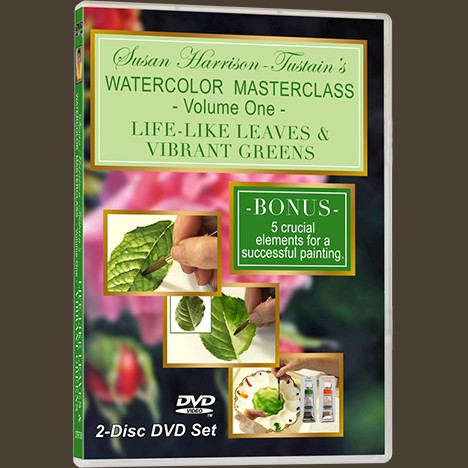
DVD: Watercolor Masterclass Volume One: “Painting Life-Like Leaves and Vibrant Greens” – for all skill levels
NZ$69.95 -

One-on-One Watercolor Workshops with Susan Harrison-Tustain – for all skill levels
NZ$69.95 -

Painting Watercolor My Way with Susan Harrison-Tustain – for all skill levels
NZ$69.95 -

Watercolor Portrait Workshop with Susan Harrison-Tustain – for all skill levels
NZ$69.95


